
Ovarian cysts diagnosis and treatment
I’d like to share my experience with ovarian cysts, but please take this warning to heart: I’m not a vet, nor do I have any medical background.
If you suspect something is wrong with your guinea pig (or any other pet), please go see your vet. I cannot stress this enough.
I absolutely encourage you to do your own research and to talk to fellow pet owners, but always do so in consultation with your vet.
TRIGGER WARNING: in this blog you will find photos of a shaved patch of fur with a scar.
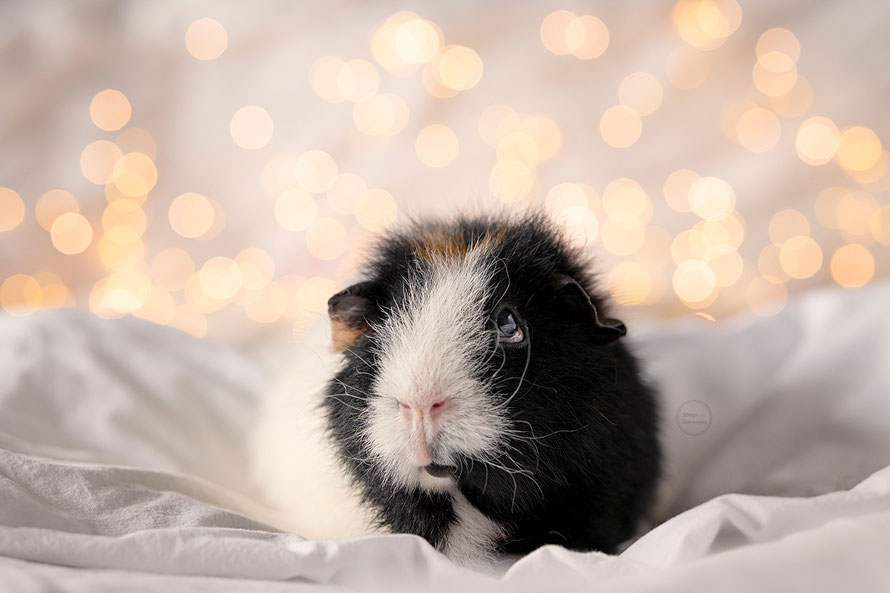
This photo was taken 14 days after surgery | EXIF: Nikon Z50 | iso 500 | 1/500 | f2.8 | 56mm
Ovarian cysts in guinea pigs are actually quite common. Wies and Pien both had them, and they were never really bothered by them. Pien occasionally got bald spots on her back, but the fur always grew back. She never seemed to be in pain or showed signs of discomfort. In Wies’ case, we accidentally discovered her cysts during a vet visit for something unrelated, but she never had any issues from them either. So if your guinea pig gets diagnosed with ovarian cysts: don’t panic. It’s very possible they may never experience any negative effects from them.
SIGNS AND DIAGNOSIS
Unfortunately, things were different for Lies. Looking back, the first sign was that her belly looked unusually large and oddly shaped. You could clearly see swellings, but because she has always been a big fluffy girl, I assumed it was just her shape.
Then she suddenly stopped eating and lost a lot of weight. When I took her to the vet, they immediately felt lumps in her belly. At that point, several diagnoses were still possible, so she needed an ultrasound.
She got one the very same day, and that’s when they discovered extremely large cysts on her ovaries. The vet was able to drain them, removing more than 80 millilitres of fluid from just one cyst, which is a huge amount for such a small animal.
Leaving them untreated was not an option, so we decided to try hormonal injections first. These can sometimes shrink the cysts. I might have had to repeat them yearly, but that was fine with me. Lies received two injections with some time in between, and she genuinely seemed much better afterward.
Unfortunately, about a month later, she stopped eating again and had to go back to the vet. The cysts had grown back tremendously, and I was given two options: surgery to remove the cysts and ovaries, or letting her go.
SURGERY OPTIONS
This was an incredibly difficult decision for me. Personally, I’m not a fan of major surgery on guinea pigs. Sadly, many don’t survive procedures like these, and even those who do can sometimes face difficult recoveries and complications afterward.
At that point, I started doing a lot of research. Thanks to the help of fellow guinea pig owners, I found a clinic about an hour away from me that could perform the surgery in a less invasive way. Instead of operating through the belly (which my regular vet would have done), they could perform the surgery through the flank. The clinic also had far more experience operating on guinea pigs and even had a specialised recovery room for them.
Something important to know about guinea pigs is that their ovaries are located near their back, so not at the bottom of their belly.
With surgery through the belly, the vet has to go all the way through and around other organs to reach the ovaries and cysts. One of the biggest risks with this method is accidentally touching or damaging the gut. And as most guinea pig owners know, their digestive system is incredibly sensitive.
With flank surgery, the ovaries are much easier to access, making the procedure significantly less invasive for the guinea pig.
What ultimately made me decide to go ahead with the surgery at the specialised clinic:
 Surgery through the flank would give her a significantly better chance of recovery, since the wound wouldn’t be on her
belly
Surgery through the flank would give her a significantly better chance of recovery, since the wound wouldn’t be on her
belly
Lies was still in good health overall, so if I wanted to go through with surgery, this was the right moment and I should not hesitate and wait too long at
the risk of her health deteriorating.
If Lies wouldn’t wake up from surgery, which is always a risk, she wouldn’t have suffered. It would have felt the same
as peacefully putting her to sleep.
The clinic simply had much more experience with this type of procedure in guinea pigs.
Out of the options, surgery at the specialised clinic felt like the lesser of two evils.
SURGERY DAY
Thankfully, I was able to make a decision fairly quickly, and my vet was able to forward Lies’ file to the specialised clinic. Otherwise, they wouldn’t have accepted her as a new patient.
It was a very stressful day (mostly for me though). Not only did we have to drive for an hour, but the surgery itself was also terrifying. Before the procedure, Lies was examined to make sure she
was fit enough for surgery, and I was informed about all the risks involved. Surgery is always risky, of course. With guinea pigs especially, anesthesia can sometimes simply be too much for their
tiny bodies, and they may not wake up afterward.
I dropped Lies off at the clinic at 9 AM, and around three hours later I received a call that the surgery had gone well. She just needed to wake up properly and get her body temperature back up. At 4 PM, I was finally able to pick her up and drive home.
They removed both ovaries, along with two enormous cysts: one the size of a mandarin and the other about the size of an egg. So it’s completely understandable now why Lies was feeling so
poorly.
I was sent home with antibiotics (Sulfatrim) and pain medication (Metacam). Thankfully, I already had gut medication (Emeprid) at home.

This is 1 day after surgery
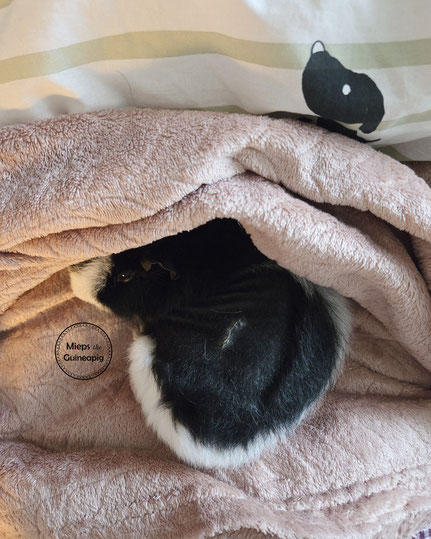
This is 11 days after surgery
Lies has had a very speedy recovery and started eating the second we came home.
She did have one off day because her gut was bothering her (which I checked with my vet), so I increased her gut medication for a bit and thankfully she improved again afterward.
Her wound was also checked by my own vet, and after 14 days she was approved to stop the antibiotics.
She’s currently still on pain medication and gut support medication. Once her weight is fully stable again, I’ll slowly lower the dosage until she’s completely off all meds.
COSTS
Now, take a deep breath and sit down when I tell you the cost, because I do want to be transparent. The surgery itself cost around €440, including the medication she needed afterward. On top of that, I spent around €40 on parking and €25 on fuel. This does not include the previous costs I made at my own vet for the ultrasound, hormonal injections and such.
A lot of money? Absolutely. But just because Lies is a guinea pig and not a larger animal like a dog or cat doesn’t mean she deserves any less care.
Thankfully, I’m in a position where I could make that decision without hesitation.
Now all we can do is hope she’ll stick around for another 4 or 5 years. 


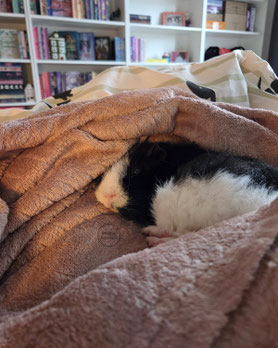
She had lots of cuddles during her recovery
If you’re from the Netherlands and would like to know which clinic I went to, feel free to contact me! I’m very happy with the care they gave Lies and would love to share my experience.
Please do keep in mind that this clinic only accepts new patients through a referral from your own vet. Calling them directly for advice or to make an appointment without a referral unfortunately won’t work and will only add unnecessary pressure to their workload. Which is the reason why I'm not naming them anywhere.
Hey... you might like this e-book!


Guinea Pig Photography Guide - Digital Download
The Guinea Pig Photography Guide will help you take cute photos of your guinea pigs or other pets. Get inspired to take your own adorable photos of your pets. This is a digital download and contains 48 pages of inspiration.
You will receive this digital download as a .pdf file via email. When you receive the notification 'your order has been shipped' I have send you the .pdf via email.
€ 4,99
including tax
- Available